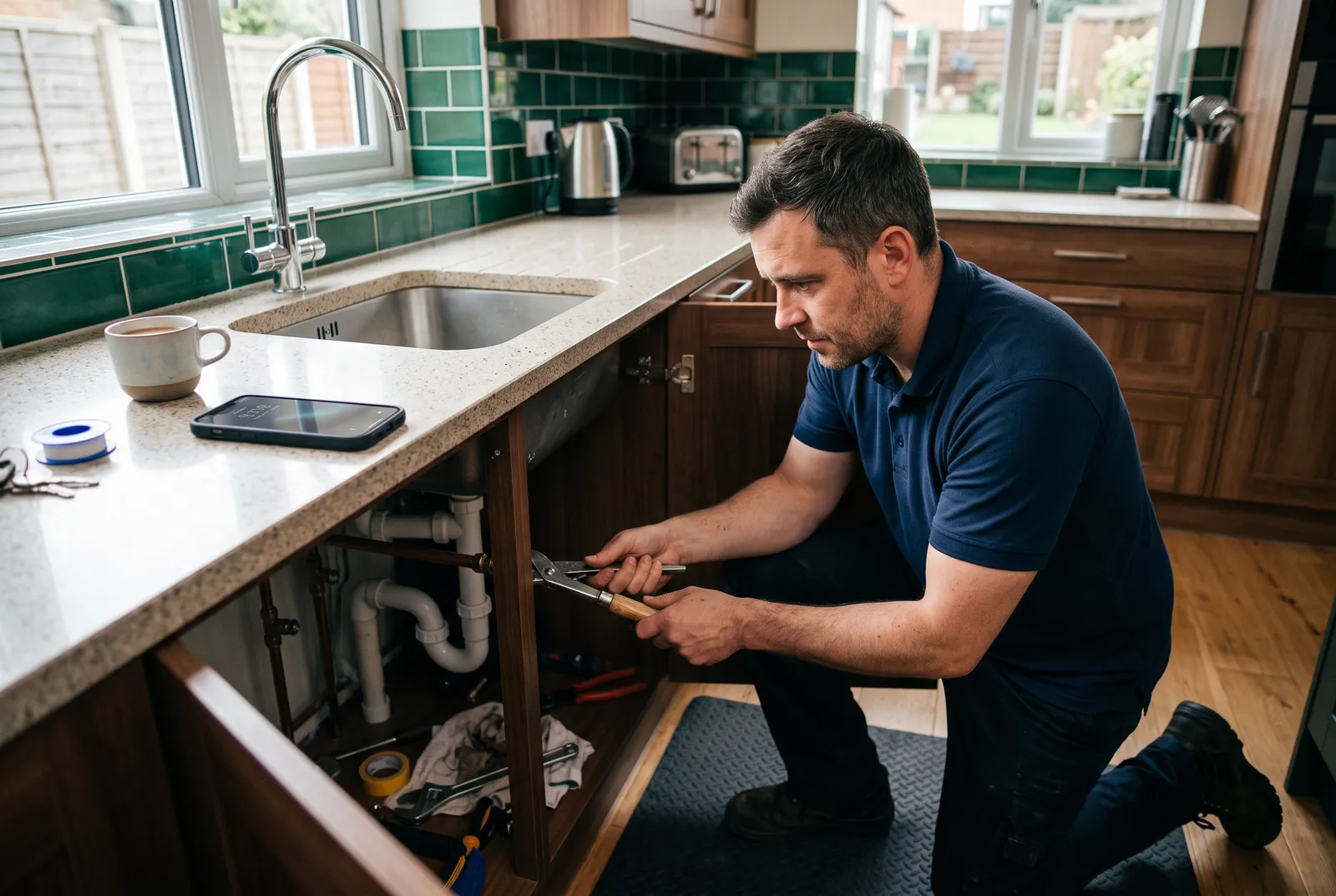
More plumbing work, booked while you’re under a sink.
Leaks, boilers and blocked drains don’t wait. Enquiries become jobs on their own, urgent ones reach whoever is on call at once, and the customer knows you’re ringing back.
- Website booking
- Job created and assigned
- Team alerted
- Customer called back
- Advert credited with the job
Get more work, without chasing it
Most trades don’t need more enquiries first. They lose the ones they already get, in the gap between the website, the office and the van.
Missed calls on the job
You can’t answer with your hands in a cupboard. The customer rings the next plumber on the list.
Emergencies after hours
Burst pipes and no hot water arrive in the evening, when the office is shut and the email waits until morning.
Wasted trips for parts
Without the boiler model or a photo of the leak, the first visit is often just to look, then back to the merchant.
Clicks that don’t book
Ads bring calls, but nobody can say which ones became paid jobs, so the budget keeps paying for the ones that don’t.
By hand
- Enquiry lands in an inbox
- Waits until someone is free
- Retyped into the job system
- Customer has booked someone else
Automated
- Customer books online
- Job created and assigned at once
- Team alerted with every detail
- Customer called back first
How it works
Five steps, none of them done by hand.
- 1
Customer books online
A short form built for phones: what they need, name, number, postcode. Spam is filtered out invisibly.
- 2
A job appears in your system
The job is created in the system you already use, with the visit pencilled in and your team assigned. Existing customers are matched, not duplicated.
- 3
Your team is alerted
The office and the engineer on call get the details at once, with a link straight to the job.
- 4
The customer knows what happens next
Their confirmation shows when you will ring and the numbers you will ring from, so they pick up.
- 5
Details and photos follow
Optional questions and photos go onto the same job, so the engineer arrives with the right kit.
Less waste, more profit
Technology-led, decisive processes replace the manual steps where time, visits and ad spend leak away.
No admin retyping
Enquiries arrive as ready-made jobs with the visit pencilled in and the team assigned. Office hours go on customers, not data entry.
First to call wins more work
Customers are called back in minutes, not hours, so fewer enquiries leak to the next business they contacted.
Fewer wasted visits
Answers and photos arrive with the job, so the engineer brings the right parts and finishes on the first visit more often.
Every lead kept
Out-of-hours, busy-day and even failed enquiries are caught, stored and followed up. Nothing depends on someone checking an inbox.
Ad budget that follows profit
Every call and booking is traced back to the advert that produced it, so spend moves to what books jobs and away from what doesn't.
Decisions in days, not quarters
Clear numbers on where visitors hesitate and which pages win work, so changes are made, tested and kept or dropped quickly.
Clean customer records
Repeat customers are recognised instead of duplicated, so history, quotes and invoices stay in one place.
Powered by AI
Automated, around the clock.
A UK services company
A family-run field-service business. Enquiries arrived by form, email and phone, and were typed into their job system by hand, often hours later.
Client name withheld at their request. Newly launched, so results will be added once there is enough data to be meaningful.
What we built
- Every online booking now becomes a job on its own, with a visit scheduled from the moment it arrives and both managers assigned. Late-evening bookings move to the next morning.
- Returning customers are recognised automatically, so the customer list stays clean and history stays together.
- Customers are told they will be called back, usually within ten minutes in opening hours, and which numbers will ring, so they answer.
- Optional questions and photos land on the same job, so engineers turn up prepared.
- No enquiry is lost: if anything fails, the lead is kept, sent to the office and retried until it lands.
- Every advert is credited with the calls and bookings it produces, and visitor behaviour is measured with consent.
- Powered by AI.
What it looks like for a plumber
Examples of how it would run day to day. They are not results from a client.
An emergency plumber
Plumbers are among the most in-demand trades in the UK, and much of their work is urgent: the business that rings back first is often the one that gets the job.
- 17:40pm: a homeowner reports a leak under the kitchen sink and adds a photo.
- 2The job is created as urgent and assigned to the engineer on call, whose phone buzzes with the address and photo.
- 3The customer's screen says the engineer will ring from a named mobile number within minutes.
- 4The engineer arrives with the right fittings, and the office sees the job and the advert that produced it the next morning.
An HVAC and plumbing company
Plumbing and HVAC are among the most searched home services in the US; “plumber near me” alone is searched around 180,000 times a month.
- 1A July heatwave: dozens of “AC not cooling” requests arrive in an afternoon.
- 2Each becomes a job with the service area, system type and photos, routed to the right technician’s schedule.
- 3Customers get an instant confirmation with the arrival window and the number that will call.
- 4Every booking is traced to its advert and zip code, so the budget moves to what books jobs.
Built for
- Plumbers and heating engineers
- HVAC companies
- Electricians
- Installers and home-tech
- Cleaning and pest control
- Estate and letting agents (valuation and viewing requests)
Questions we get asked
Can urgent jobs be handled differently?+
Yes. Leaks, no heating and no hot water can be flagged as urgent and sent straight to whoever is on call, while routine work waits for the office.
How do I get more plumbing work without buying leads?+
Win more of the enquiries you already get: answer faster, book automatically and follow up every one. Then put ad budget only behind the searches that turn into booked jobs.
Will it work with the system we already use?+
Almost certainly. We connect to the job, ticketing or customer system you already run, so your team keeps working the way they do now.
Do we need a new website?+
Not always. The booking process can be added to an existing site. Where the site itself is costing enquiries, we rebuild the pages that matter.
What if something goes wrong?+
Every enquiry is saved before anything else happens. If a step fails, it is retried automatically and the office is told, so nothing is lost.
Is the measurement compliant with UK and EU privacy law?+
Yes. Advertising measurement runs only with the visitor’s consent, and the rest follows the rules for anonymous statistics, with a clear notice and opt-out.
How long does it take?+
A typical setup takes a few weeks: a short discovery call, building the process, testing with real enquiries, then launch.
See where your enquiries go missing
Tell us how enquiries reach you today and which job system you use. We will show you what can be automated.
Get in touch